
Have you ever stepped on the scale on a Monday morning and watched the number climb up a few pounds higher than it was on Friday? That little internal gasp, the quick mental replay of everything you ate on Saturday, the immediate promise to eat nothing but salad and steamed broccoli for the rest of the week.
Before you start mentally preparing a diet regime for the week, let me save you some time: you did not gain 5 pounds of body fat over the weekend. It’s not physically or biologically possible, and I’ll tell you why in a minute.
Overnight weight gain sucks. But what you need to know is that although what the scale shows you is real weight, it isn’t fat. So why does this happen with such startling regularity?
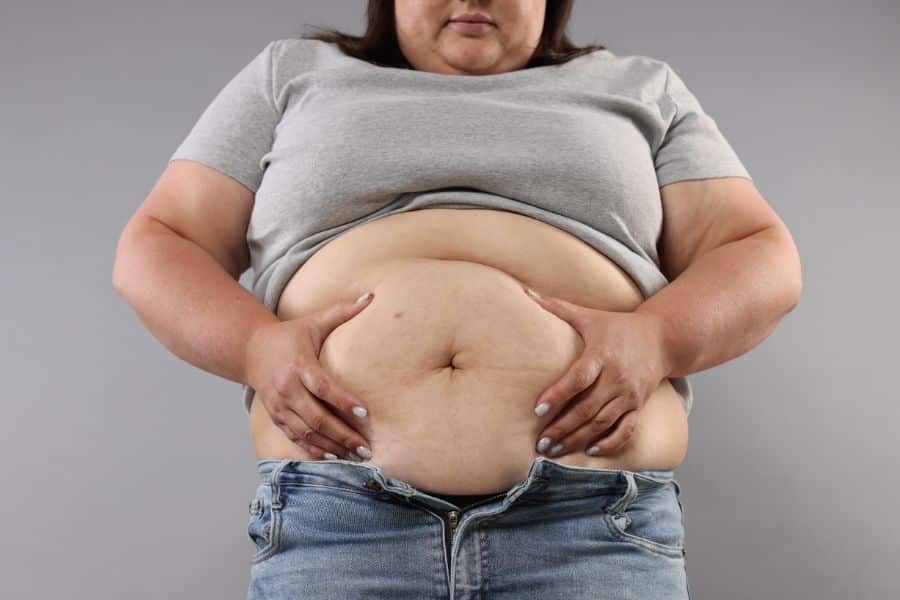
The Weight Loss Sawtooth Pattern
When we think about our weight, we expect to see a graph with a line that starts at the top and slopes down, representing your weight loss. Unfortunately, our bodies aren’t a graph on an Excel spreadsheet. They don’t act that way.
They wobble, spike, and dip, but there’s a fairly predictable rhythm to it once you know what you’re looking at.
A study published in Obesity Facts tracked the daily weigh-ins of 80 adults over a full year and found a clear zig-zag they called a sawtooth pattern. Weight tended to creep up starting on Saturday, peak on Monday, and then trickle back down through the week, hitting its lowest point on Friday morning. Every single week. Like clockwork.
The people in the study who successfully kept weight off long-term still had the weekend bump; they weren’t magically immune, they just slid back into their weekday routine on Monday without treating that number as a moral failure.
The Math That Should Convince You
To actually gain a pound of body fat, you need to eat roughly 3,500 calories more than you burn. That’s the number for one single pound of adipose tissue.
So if you gained 5 pounds of real fat over a weekend, you’d need to have eaten a surplus of 17,500 calories on top of the 4,000 or so your body naturally burns just being alive for two days. That’s around 21,500 calories between Saturday breakfast and Sunday bedtime.
Let me put that in food terms.
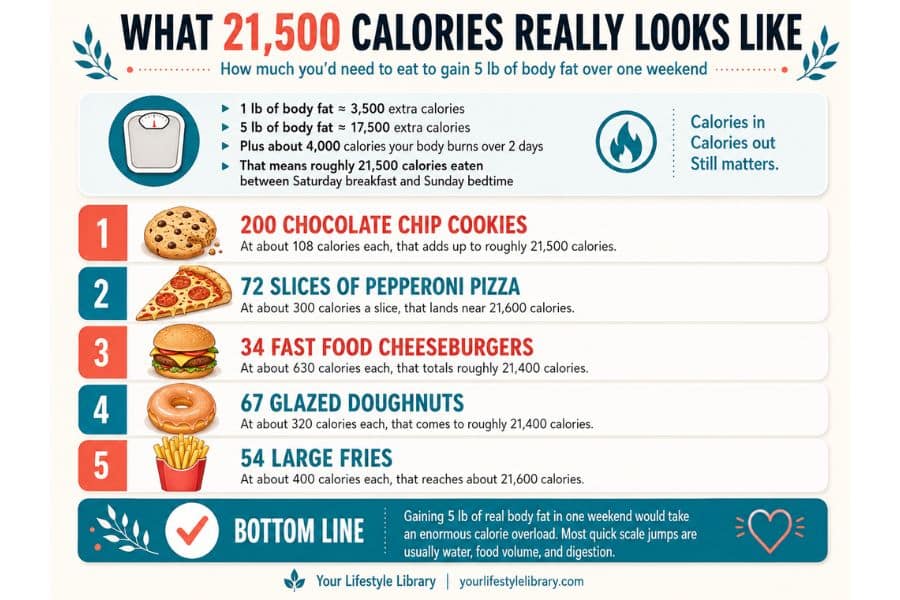
It’s a physically impossible amount of food, and I promise you didn’t do it, no matter how bad Sunday felt.
Even a really enthusiastic weekend, with brunch and a couple of glasses of wine and a bigger dinner than usual, probably lands you somewhere around 3,000 to 4,000 extra calories total. That’s maybe half a pound of actual fat gain at the very worst. So where’s the other four-and-a-bit pounds coming from? That’s the interesting bit.
Your Muscles Are Basically Sponges
The biggest chunk of that Monday number is almost always about carbohydrates and water. When you eat bread, pasta, rice, or anything sugary, your body breaks it down into glucose.
Whatever you don’t burn off immediately is stored in your muscles and liver as glycogen, your backup fuel for later.
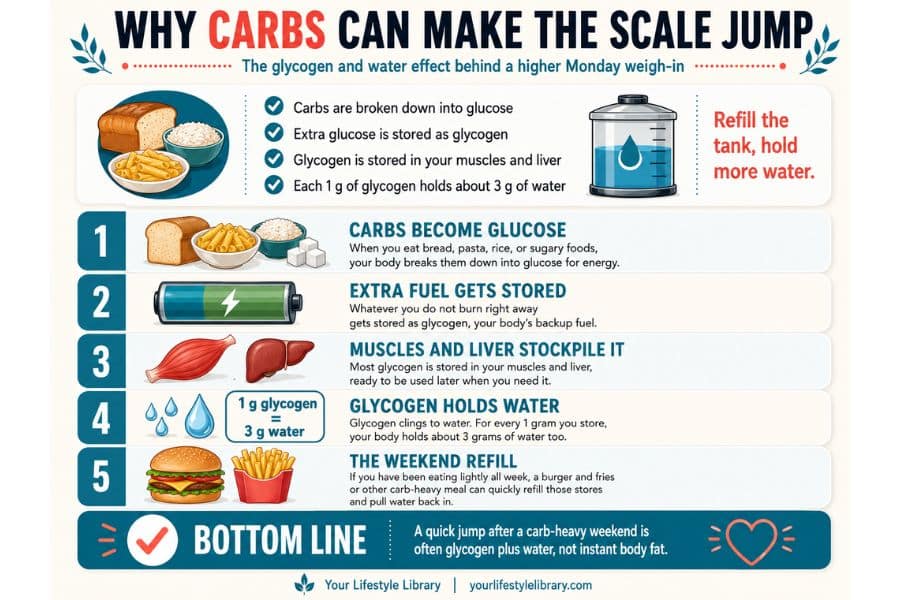
Glycogen has a quirk, though. It clings to water. For every gram of glycogen you store, your body holds onto roughly 3 grams of water. So if you’ve been eating lightly during the week and running your glycogen stores down, then you have a burger and fries on Saturday night, your body basically shouts “finally!” and refills the tank.
Store about 14 ounces of glycogen, and you’ll pick up close to 42 ounces of water with it. That’s nearly 3.5 pounds on the scale, and none of it is fat.
Athletes actively try to reach this state before an event. It’s called being fully carb-loaded, and it’s the same thing that’s happening to you on Monday morning. You’re just fueled up.
The Salt Issue
Then there’s sodium. Your body is obsessive about keeping the salt concentration in your blood within a very narrow range. When you eat a meal that’s heavy on sodium, and you can hit 3,000mg or more from a single restaurant dinner without even trying, your blood tips into the salty end of that range.
To fix it, your body releases antidiuretic hormone, which tells your kidneys to hang onto water instead of flushing it out, so the excess sodium gets diluted back down to a comfortable level. Instead of peeing normally, you retain fluid.
A weekend of takeout, soy sauce, cured meat, or salty snacks can leave you holding around 2 liters of extra water, and since a liter of water weighs roughly 2.2 pounds, that’s another 4-plus pounds sitting on the scale for no other reason than that your kidneys are doing their job.
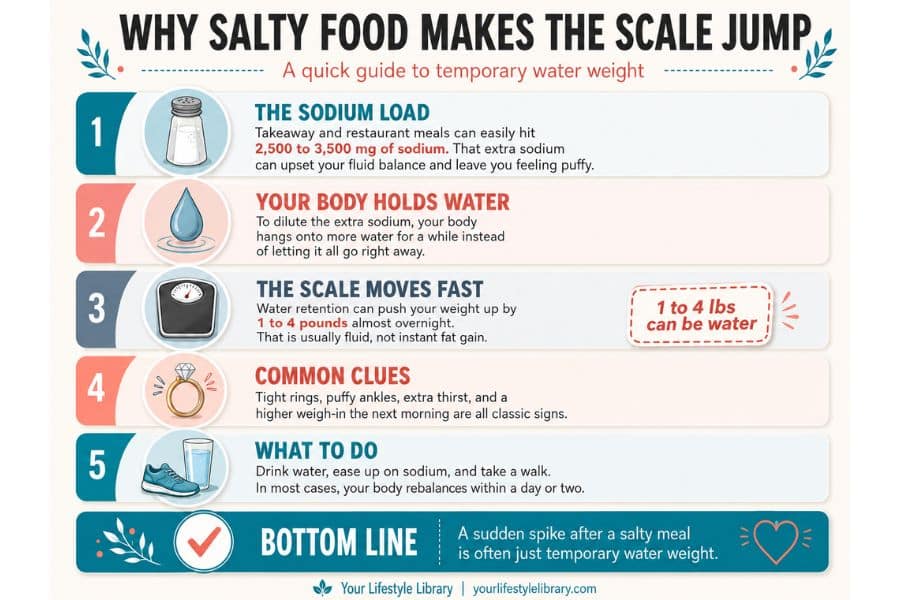
This is why our ankles look a bit puffy, and your face seems a little rounder in the mirror on Monday.
It’s dilution work, not fat, and it will sort itself out within a couple of days of normal eating and drinking water.
The Blockage in Your Gut
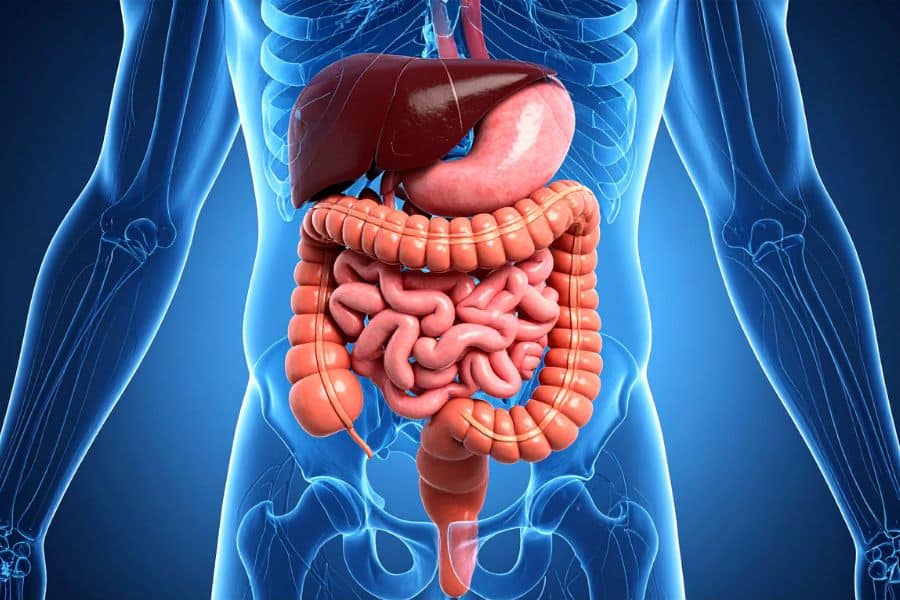
Food has weight before your body has finished with it. Your digestive tract is around 30 feet long, and transit time from mouth to exit can range from 24 to 72 hours, depending on what you ate and how your gut is feeling that week.
If Sunday’s dinner was a steak, or a rich pasta, or something low in fiber, that food is physically still inside you when you step on the scale Monday morning. It hasn’t finished the journey yet.
The average person carries between 1 and 2 pounds of digestive contents at any given time, and after a big low-fiber, alcohol-heavy weekend, that number can easily bump up.
Alcohol adds its own twist, and it hits you in two waves. On Saturday night, it acts as a diuretic, blocking that same antidiuretic hormone we talked about, so you pee more and end up dehydrated by the time you fall asleep.
Then, by Sunday, your body clocks the dehydration and overcorrects, holding onto every drop of water it can find to rebalance. Alcohol can also irritate the lining of your gut, which causes localized swelling. That bloated Sunday belly is inflammation from the drinks you had the night before.
How to Stop Letting Monday Ruin Your Week
The number on the scale isn’t a judge. The problem isn’t the weekend bump, because that’s happening whether you notice or not. The problem is what we do next.
Panic-dieting, skipping meals, and doubling up on cardio to “undo” a weekend of food are the exact behaviors that spike cortisol, which then causes your body to hold onto even more water. You end up chasing your own tail.
Dr. Leslie Heinberg at the Cleveland Clinic has said the scale is a terrible measure of behavior change because you can do everything right and still be up 2 pounds on any given morning for reasons unrelated to what you ate.
Once you accept that, the Monday number stops having so much power over your mood.
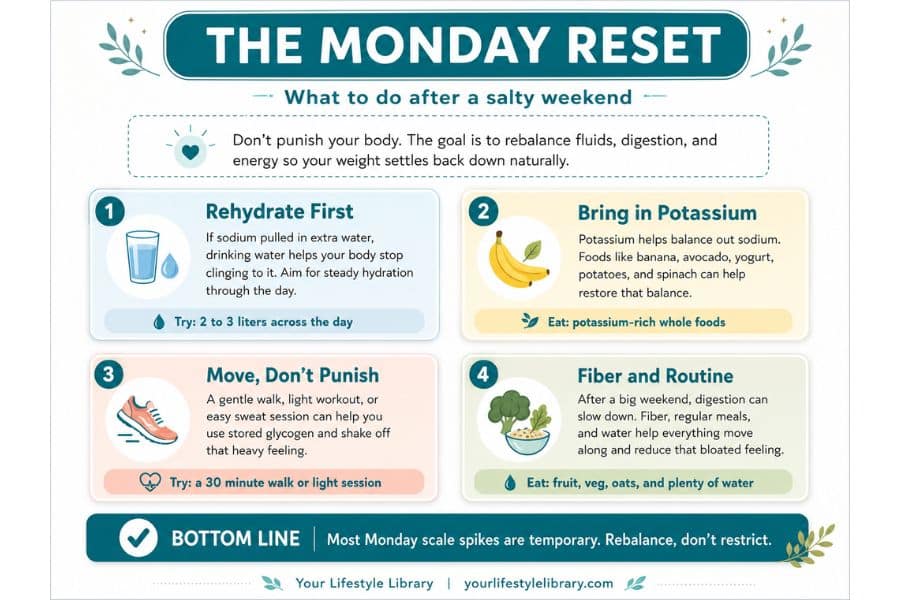
Here are the things worth trying instead:
- Weigh yourself on the same day each week, ideally a Wednesday or Thursday morning, so you’re not catching yourself at the peak of the sawtooth. If you like daily data, look at the 7-day average, not the individual number.
- Drink plenty of water on Monday. It sounds counterintuitive when you’re holding fluid, but hydration signals your kidneys to let the excess go.
- Eat normally. Normal meals, protein, fiber, vegetables, the works. Skipping breakfast to compensate is what keeps the stress cycle spinning.
- Get a walk in. Nothing punishing, just movement to help digestion catch up and support circulation, which nudges retained fluid along.
- Rewrite the story in your head. Instead of “I gained weight,” try “my glycogen is topped up and I’m rehydrating.”
Disclaimer: The content in this article is for informational purposes only and is not intended to replace professional medical advice, diagnosis, or treatment. Always consult your doctor, physical therapist, or healthcare provider before starting a new exercise program, particularly if you have existing joint, cardiovascular, or balance conditions.

Kylie Lang is a nationally syndicated travel journalist with bylines on the Associated Press Wire & more, a lifestyle writer, and the founder and editor of Your Lifestyle Library (yourlifestylelibrary.com). She holds a BA (Honours) in History from the University of Kent and is a member of the British Guild of Travel Writers.