
After the summer, all I want to do is get out in the garden and show it some much-needed love. It’s a train wreck out there right now, which is so sad, since I put in so much work in spring.
At this time of year, you know whatever you do, you’re not really going to see it return to its full flowering glory till next year. However, some shrubs will take you halfway there and start making it look like a garden again instead of a dry wilderness.
Bamboo in a nice big pot, a shrub covered in red berries, a little ivy in a hanging basket that would look lovely trailing over the fence. The trouble is, pretty much all of these are invasive plants that will take over your yard without so much as a by your leave. Then you’re left with a whole world of trouble trying to get rid of them.

5 Invasive Plants To Avoid This Fall
So the big question is, which should you plant and which should you avoid? These five are probably the most common and the ones you need to be aware of before getting handy with your gardening fork.
1. Bamboo

Bamboo looks fab when you walk past it in someone else’s garden. We have quite a bit of it in France, and it’s perfect for screening off the ugly areas, including something unsightly in your neighbor’s garden.
Don’t do it. I did it, or actually my French neighbor Stephane did it for me, thinking he was doing me a favor. Oh, good God, I couldn’t get rid of the stuff. In the end, I had to pour bleach into the roots and cover them with a tarp all winter. Even then, digging them up was a nightmare.
There are two broad types. Clumping bamboo tends to stay where you put it and grows outward slowly in a tight clump.
Running bamboo sends long underground rhizomes out sideways, and those rhizomes can travel 20 feet or more, popping up through your lawn, your gravel path, and the cracks in your driveway. That’s the sort I battled with last year.
If you want the height and the movement without the invasion, plant feather reed grass instead. Karl Foerster is perfect as it stands up straight in wind and rain, turns a lovely wheat color through fall, and stays exactly where you plant it.
Top Tip: If you inherit running bamboo with a house, deal with it in the first season. It doesn’t get easier.
Found this useful? Get more like it in your inbox as a Lifestyle Library Insider.
2. Nandina and Japanese Barberry

Nandina, sometimes sold as heavenly bamboo (it isn’t a bamboo), is one of those foundation shrubs you see planted around every other house in the South: feathery foliage, red berries in fall, low maintenance.
What the label doesn’t say is that it’s listed as a Category I invasive by the Florida Invasive Species Council, spreads by seeds birds carry into the woods, and also by suckers along the ground where you planted it.
Japanese barberry is the other one to walk past. It’s the small thorny shrub with burgundy or lime leaves, tough as old boots and happy in almost any soil. It’s also banned or restricted in a growing list of states, including Pennsylvania, because it forms dense thorny thickets in the woods that shade out everything native.
Ticks love it, mice love it, and the thorns will love your hands when you eventually try to pull it out.
For berries and fall color, American beautyberry is a swap for nandina, with gorgeous, bright purple berries. For burgundy leaves and a generally shrubby shape, look for ninebark. Summer Wine is a good choice, and pollinators can enjoy it too.
3. Montbretia

Crocosmia crocosmiiflora, sold as montbretia, is the arching plant with the fiery orange flowers that looks glorious in a border for about two years. Then it starts to spread from underground corms and seed, and once it does, it doesn’t stop.
It’s listed as invasive in North Carolina and across the West Coast, where it’s escaped gardens and formed dense mats along roadsides and in wild areas, smothering native plants.
Once you’ve got it, digging it out means finding every last corm, and if you leave one behind, it comes back.
What you want instead is a variety called Lucifer, with tall scarlet flowers, which is far better behaved.
4. English Ivy

English ivy looks gorgeous climbing up an old cottage with a thatched roof, but boy is it ever invasive. My mom used to call me her little clinging ivy when I was a little girl because I was always holding onto her arm and stuck by her side. Get the picture?
As a ground cover, it outcompetes everything around it and turns into a solid mat that rats and mice absolutely love. As a climber, it uses aerial roots that penetrate brick, mortar, wood siding, and tree bark.
It will climb a mature oak, shade out the canopy, and eventually help kill the tree. Washington state lists it as a Class C noxious weed, and I can understand why.
If you want a low, spreading, evergreen ground cover, kinnikinnick (also called bearberry) is the native alternative. It stays under a foot and a half tall, spreads about six feet across, and turns red-purple in fall.
Bees will enjoy the flowers, and birds eat the berries.
5. Three-Cornered Leek
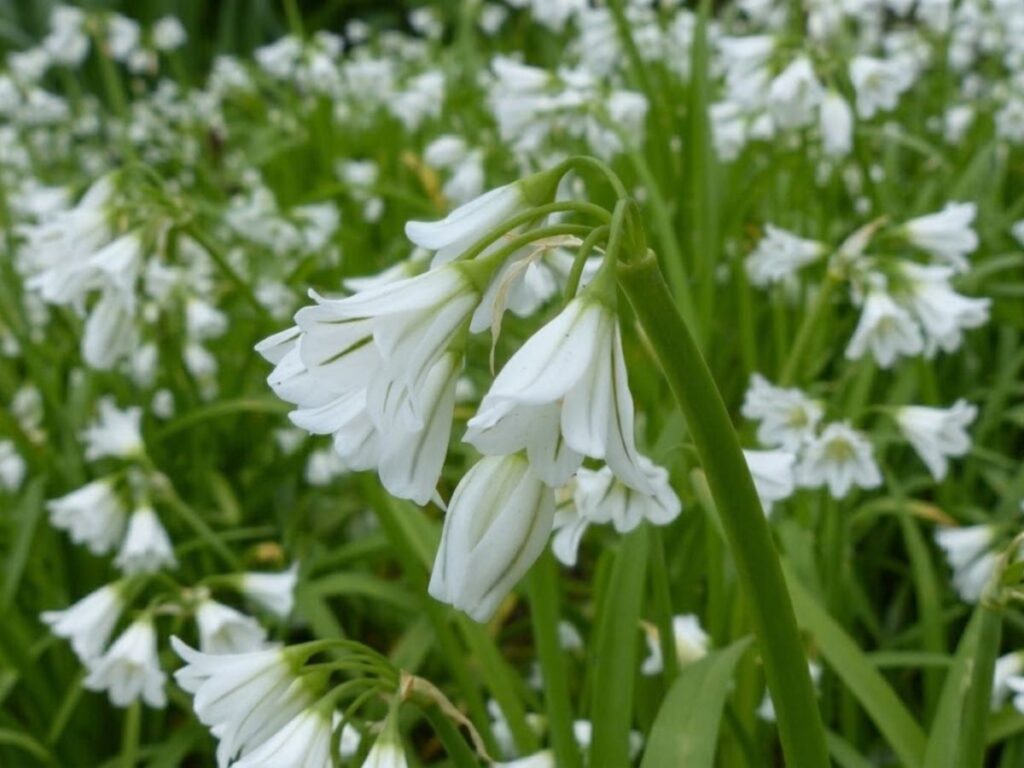
The three-cornered leek is an allium with pretty white, bell-shaped flowers and a mild garlic flavor. It multiplies from tiny bulblets, spreads by seed, and within a couple of seasons it’s in every bed, every gravel path, and the edges of your lawn.
Pulling it up leaves the smallest bulblets behind, and those become next year’s plants. It’s on invasive lists in several states and does real damage when it escapes into woodlands.
Suppose you want an ornamental allium for the border, plant one-leaf onion instead. It’s native, flowers pinky-purple in late spring, and stays where you plant it.
Disclaimer: This article is for general information only and is not professional advice. It may contain affiliate links. Please see our full Editorial Policy for details.
Become a Lifestyle Library Insider
Health tips, money know-how, travel deals and garden ideas for life after 50, straight to your inbox.

Kylie Lang is a nationally syndicated travel journalist with bylines on the Associated Press Wire & more, a lifestyle writer, and the founder and editor of Your Lifestyle Library (yourlifestylelibrary.com). She holds a BA (Honours) in History from the University of Kent and is a member of the British Guild of Travel Writers.