
Ornamental grasses are a big trend. Every garden magazine cover, every Chelsea recap, every Pinterest board that used to be all dahlias and delphiniums now has these soft, feathery clumps swaying about between the flowers.
They can quickly and easily liven up a dull border. Watching them as the wind catches them in a breeze brings them to life.
Grown properly, interspersed with the right flowers and plants, you can absolutely transform a garden without too much hard work. But which are the right ones to buy that won’t completely take over, hiding your beautiful flowers?
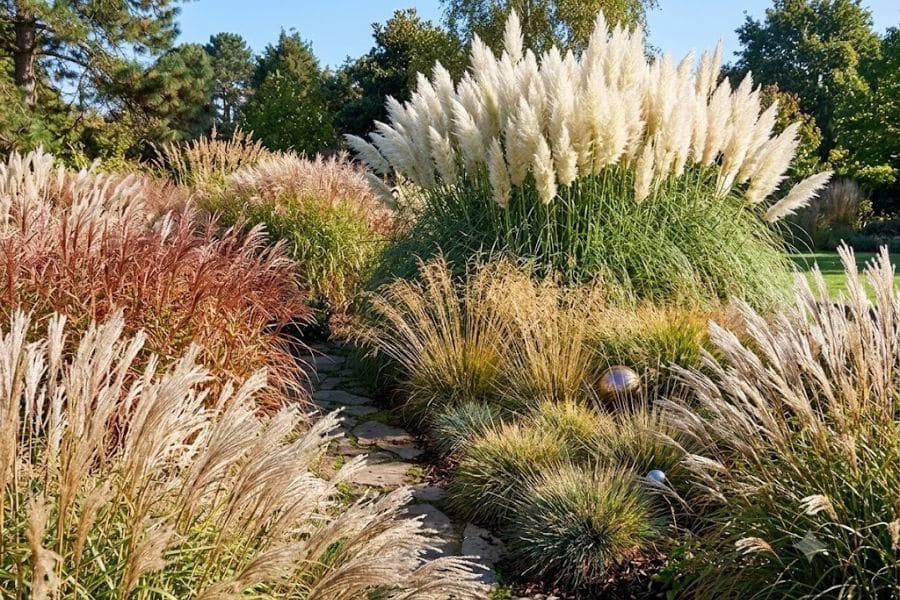
7 Ornamental Grasses For Your Garden
Ornamental grasses aren’t something I know a lot about, so I decided to defer to a friend from the events industry, a floral designer. She uses them a lot in different displays, but she’s also a keen gardener and was able to point me in the right direction.
1. Mexican Feather Grass (Stipa tenuissima)
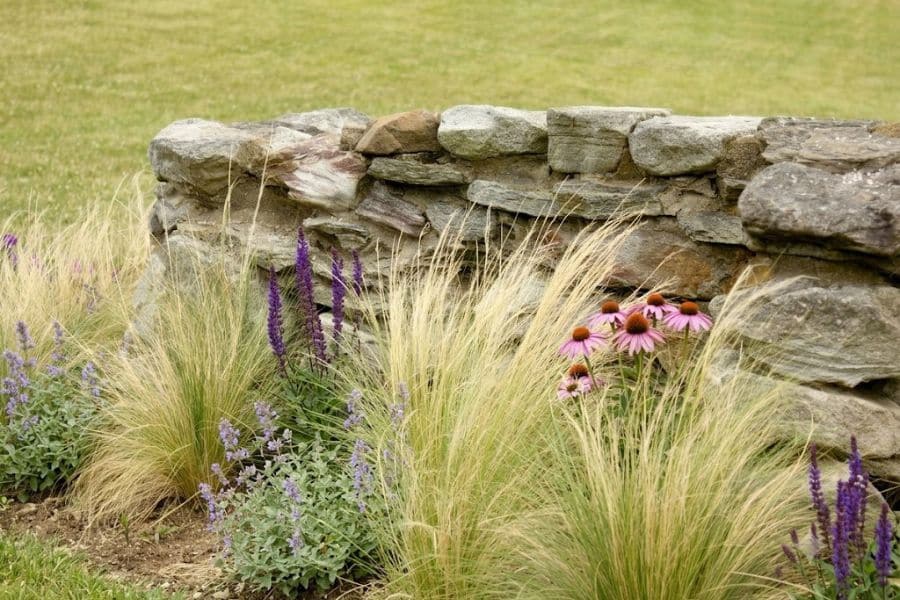
This is the one I’d start with if you’ve never grown a grass before. It forms a soft, hair-like clump about 18 to 24 inches tall, pale green in early summer and turning a lovely wheat-blond by August, and it moves in the slightest breath of air.
Even on a still day it seems to shiver slightly. I can’t help but run my hand through it every time I walk past.
It likes full sun and well-drained soil, and it will self-seed a bit if it’s happy, which some people love, and others find annoying. I love it as my French garden is organized chaos, so it works.
If you’re like me, just pull the seedlings out in spring while they’re small. It doesn’t spread by runners, so you won’t end up with a lawn of the stuff.
Good partners include roses, salvias, catmint, and echinacea. Anything with structure and color gets softened by it.
2. Purple Moor Grass (Molinia caerulea ‘Transparent’)
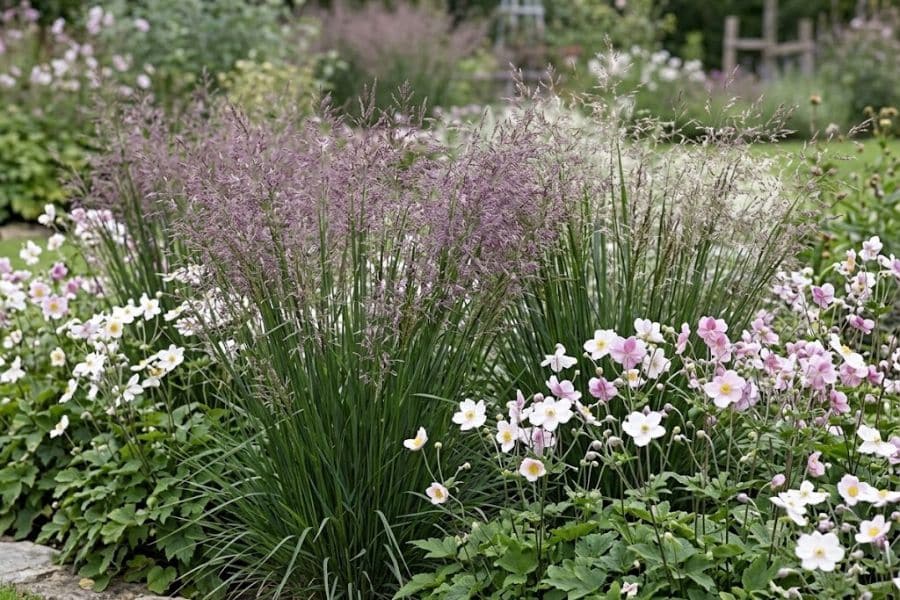
The name tells you what you need to know. This one grows into a tidy clump of green foliage about 2 feet high, then throws up tall, airy flower stems, sometimes 5 or 6 feet tall, that you can see straight through.
Which, of course, means you can plant it toward the front or middle of a border and not lose everything behind it.
Molinia is slow to get going in spring, so don’t panic when everything around it is up, and it’s still looking like a patch of nothing. By July, it’s up; by August, it’s flowering; and by September, it’s turning a warm gold that lasts into fall. Then in late fall the whole thing collapses of its own accord, which saves you a cutting-back job. Handy.
It prefers a bit of moisture in the soil, so it’s not the one for a dry gravel bed, but in normal border conditions it’s easy. Pair it with late-season perennials like Japanese anemones, asters, and sedum, and you’ve got a border that peaks when a lot of others are winding down.
3. Feather Reed Grass (Calamagrostis x acutiflora ‘Karl Foerster’)
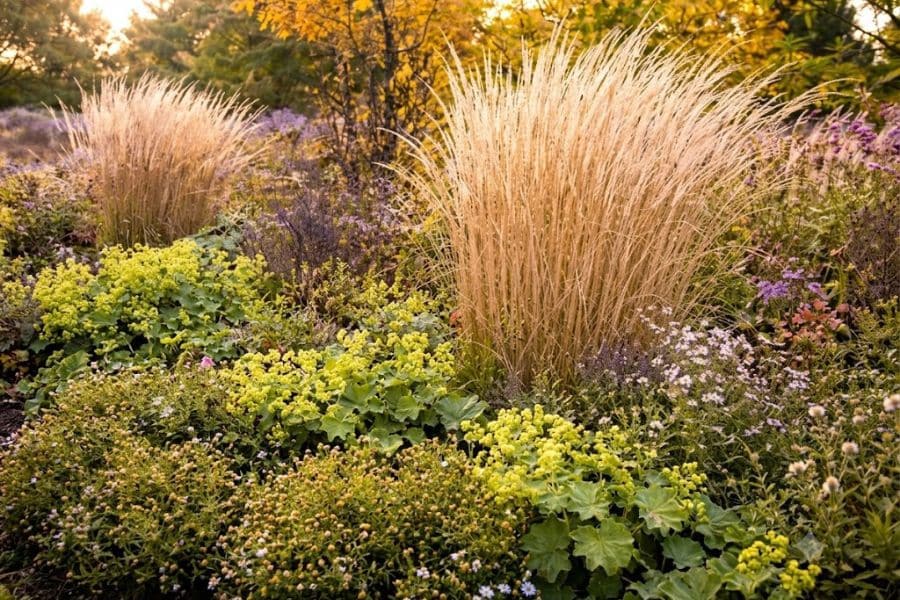
If you want something upright and architectural, this is the one. Karl Foerster (yes, named after a real German plantsman) grows straight up to about 5 feet, tight and upright, with wheat-colored flower spikes that appear in early summer and remain standing all winter.
It’s the exclamation point in a border, and it doesn’t flop, which is a small miracle in the grass world.
I love it because it gives a border height without taking up much ground space. The clump stays about 2 feet across, so you can slot it into quite a modest bed and it won’t muscle everything else out.
It’s sterile too, so no self-seeding to worry about. You cut it down in late winter or early spring, right to the ground, and it comes back cleanly.
It looks brilliant repeated three or five times through a border rather than as a single specimen. Underplant with lower perennials like geraniums, alchemilla, or lower asters, and let the vertical lines of the grass do the drama. In winter, when everything else is gone, those tan spikes catching frost are one of the best things in the garden.
4. Japanese Forest Grass (Hakonechloa macra)
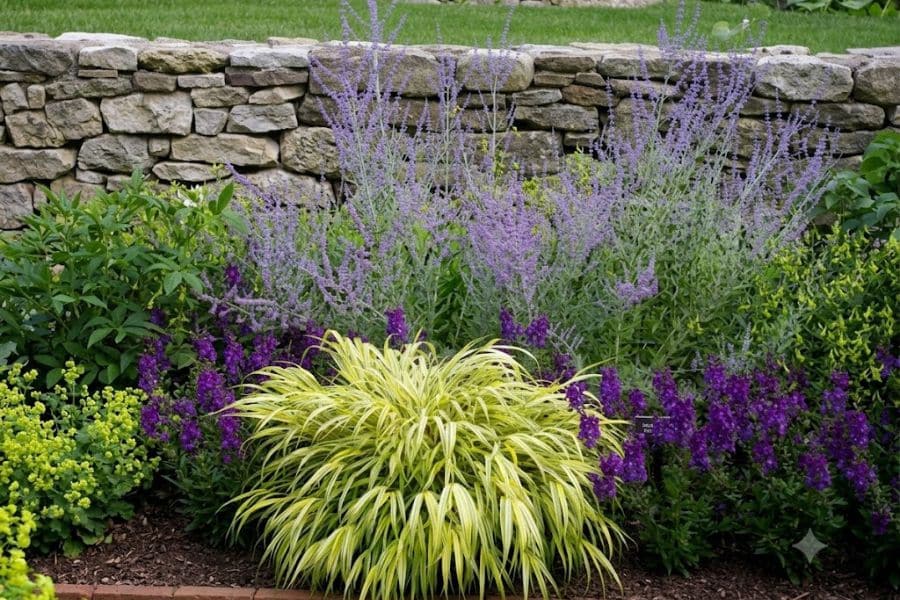
Everything else on this list wants sun. This one wants shade, or at least dappled light, which makes it the answer to a question a lot of us have: what on earth do you put in that shady bit next to the fence?
Hakonechloa grows in cascading mounds about 12 to 18 inches high, and the leaves flow in one direction like water pouring down a hillside. It’s beautiful.
The plain green form is lovely, but the golden variety ‘Aureola’ is the one you’ll see everywhere, and it lights up a shady corner like nothing else. There’s a lime-green one called ‘All Gold’ too if you want something even brighter.
It’s slow-growing, so don’t expect a big clump in year one. Mine took about 3 years to look properly established, and I nearly dug it up in year 2 thinking it wasn’t going to do anything. Glad I didn’t.
It likes moist, humus-rich soil, so mulch it well and don’t let it bake dry in summer. Pair it with hostas, ferns, heucheras, and epimediums, and you’ve got a shade bed with real texture rather than just a lot of green leaves sitting there looking the same.
5. Blue Fescue (Festuca glauca ‘Elijah Blue’)
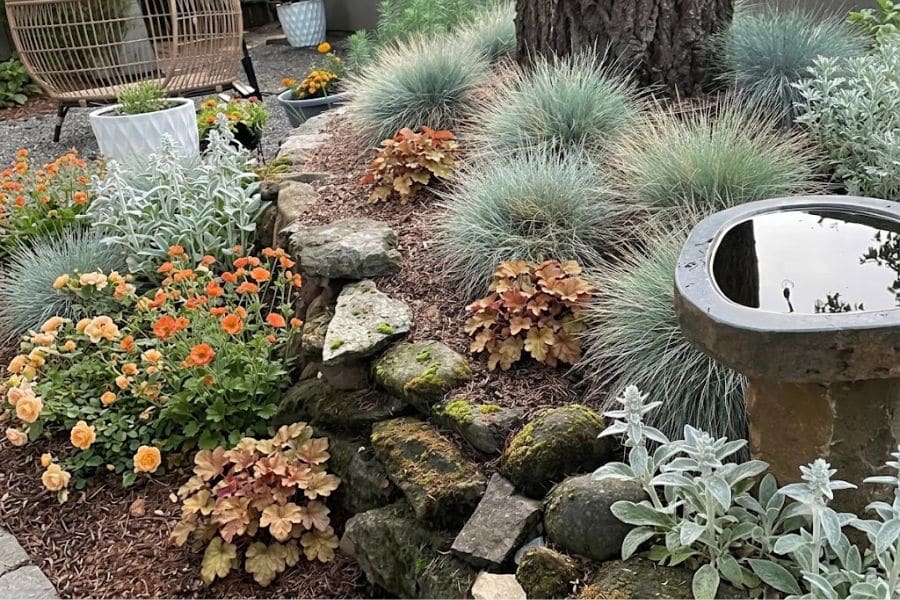
A little tuft of a thing, about 8 to 10 inches high, in a proper silvery-blue that looks almost powdery from a distance. It’s the grass for the front of the border, or for a gravel garden, or for edging a path, and it stays exactly where you put it. No spreading, no seeding around, no drama. My kind of plant.
It does need full sun and sharp drainage. If your soil is heavy clay that stays wet all winter, it will rot, sulk, and eventually die on you, so either amend the spot with grit or grow it in a pot.
It also tends to look tired after 3 or 4 years, at which point you dig it up, split it into smaller pieces, and replant the freshest bits.
It looks fantastic next to anything with warm colors, orange geums, apricot roses, bronze heucheras, or with silver-leaved plants like lamb’s ear and Artemisia.
6. Switch Grass (Panicum virgatum ‘Shenandoah’)
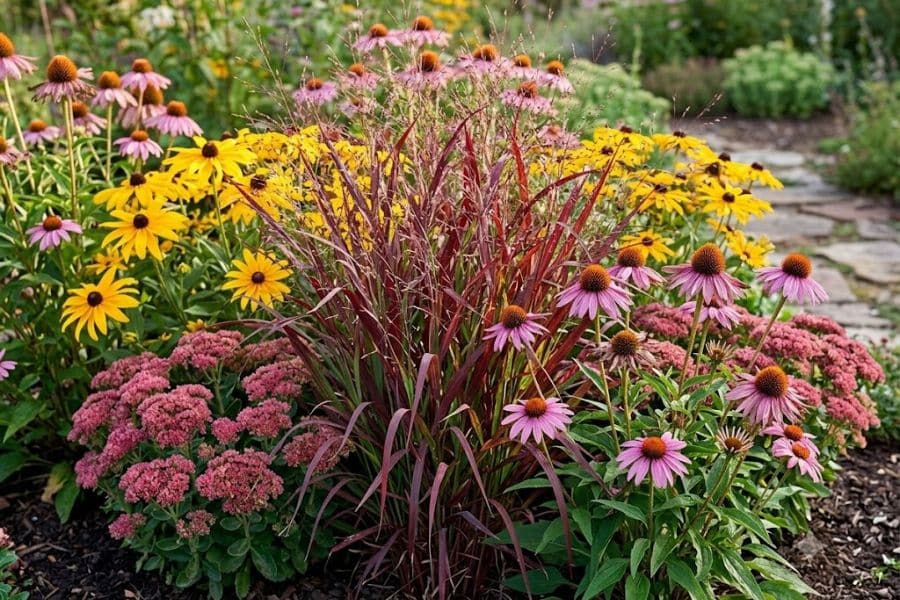
Switch grass is native to the American prairies, so if you’re in the US, it’s already at home wherever you are. ‘Shenandoah’ is the variety I’d point you toward because the tips of the leaves turn a rich red-burgundy from midsummer onward, deepening as the weeks go on, and by fall the whole plant is a wine-red column about 3 to 4 feet tall.
It’s a really good-looking plant.
It sends up airy, pink-tinted flower panicles in late summer that hover above the foliage like a cloud of tiny beads. Bees and small birds like it, and it stands through winter without collapsing, so you get months of value from one clump. Full sun, average soil, no fuss. It’s drought-tolerant once established.
Pair it with rudbeckia, echinacea, sedum ‘Autumn Joy’, and later-flowering salvias for a prairie-style patch that peaks in September. If you want the wilder new-perennial look but you don’t want a whole meadow, one or three Panicums slotted into a normal border will get you a long way toward it.
7. Fountain Grass (Pennisetum alopecuroides ‘Hameln’)
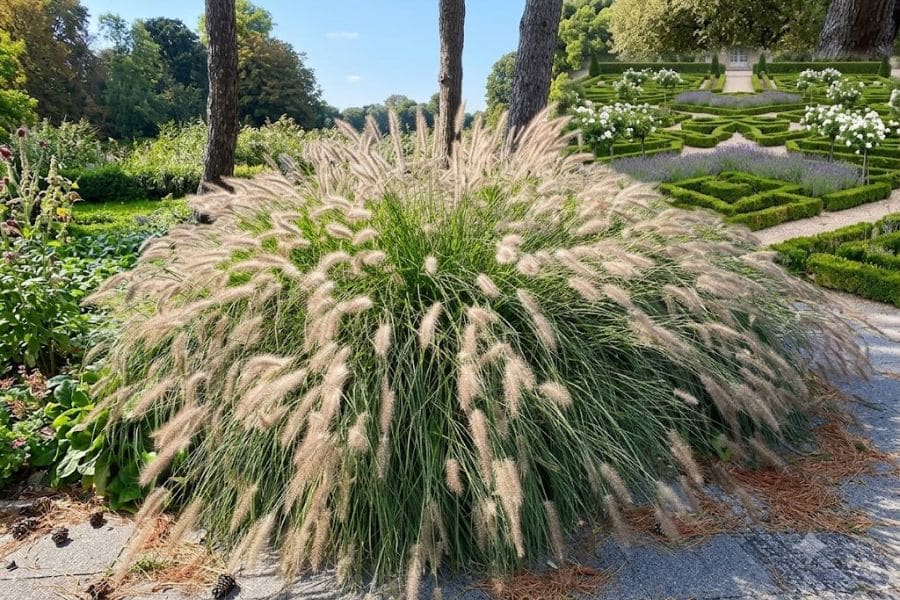
The bottlebrush one. Fountain grass grows in a neat, arching mound about 2 to 3 feet high, and in late summer it throws out these soft, fuzzy flower spikes that look exactly like foxtails, or bottle brushes, depending on your frame of reference.
Everyone wants to touch them, and you should, because they’re gorgeous.
‘Hameln‘ is a compact form that stays tidy and flowers reliably even where summers aren’t scorching. The larger species types can be a bit shy about flowering in cooler climates, so if you’re in a shorter-summer area, stick with ‘Hameln’ or ‘Little Bunny’, which is even smaller. Full sun, decent drainage, cut down in early spring before new growth starts.
It’s brilliant next to late-summer flowers, especially anything with a bold flat flower head like sedum or achillea, because the contrast between the round mound of grass, the fuzzy vertical spikes, and the flat plates of the flowers gives you three different shapes doing three different things in the same square yard.

Kylie Lang is a nationally syndicated travel journalist with bylines on the Associated Press Wire & more, a lifestyle writer, and the founder and editor of Your Lifestyle Library (yourlifestylelibrary.com). She holds a BA (Honours) in History from the University of Kent and is a member of the British Guild of Travel Writers.