
How many times have you done one of those quizzes on Facebook that tells you what Harry Potter House you’d be in or which Friends character you’re most like? I know I’ve done a fair share of them. They’re fun, and who doesn’t want to know what house they’d belong to if they went to Hogwarts?
Well, it turns out there are personality quizzes that show how your relationship with money predicts your wealth. And this isn’t just a fun test someone made up to pass a few minutes while scrolling through social media. There’s solid research behind the link between personality and financial outcomes.
The way you’re wired, how you think about risk, what money means to you, and what keeps you up at night, shapes every financial decision you’ve ever made. Psychologists call this your wealth personality. And once you know yours, the whole picture starts to make sense.
Take the money personality test below first. Then read on to find out what it means for your retirement.
Take the Money Personality Test
The 5 Money Archetypes Explained
Your archetype is a map. It shows you where your natural strengths are, where you’re likely to self-sabotage, and what you need to fix before retirement arrives.
The Strategic Accumulator

You are the marathon runner of personal finance. Security is everything to you. You track your net worth, you budget carefully, and you enjoy watching your savings grow.
Your strength is consistency. You do the boring stuff that most people skip, and compounding rewards you for it over time.
Your blind spot is fear. Loss aversion hits you hard. The pain of losing money feels so real that you sometimes avoid investments that carry any risk at all, even sensible ones. You might also be so focused on accumulating that you forget to actually enjoy what you’ve built.
For retirement, this means you could arrive with a solid pot of money but still feel anxious about spending it. Work on giving yourself permission to use what you’ve saved.
The Maverick Creator

You see money as a tool for impact. You want to build something such as a business, a product, a brand, something that didn’t exist before you came along.
Your strength is vision and resilience. You’re not afraid to fail and try again, which is exactly the mindset behind most real wealth creation.
Your blind spot is the details. You can be wildly disorganized when it comes to the boring mechanics of money. Taxes, pension contributions, and bookkeeping. These things bore you, and neglecting them quietly drains your future.
For retirement, you may also suffer from shiny object syndrome, jumping between ventures without seeing any one thing through long enough to generate lasting wealth. Discipline is your missing ingredient.
The Connector

You believe your network is your net worth, and you’re not wrong. You build relationships effortlessly, you’re a natural negotiator, and you open doors that others don’t even know exist.
Your strength is people. The deals you find, the partners you attract, and the opportunities that come through relationships are valuable.
Your blind spot is generosity. You lend money when you shouldn’t, pick up tabs, and inflate your lifestyle to match the people around you. All of that erodes your retirement savings in ways that are hard to see until it’s too late.
For retirement, building wealth through connection is powerful, but only if you have firm financial boundaries in place alongside it.
The Artisan
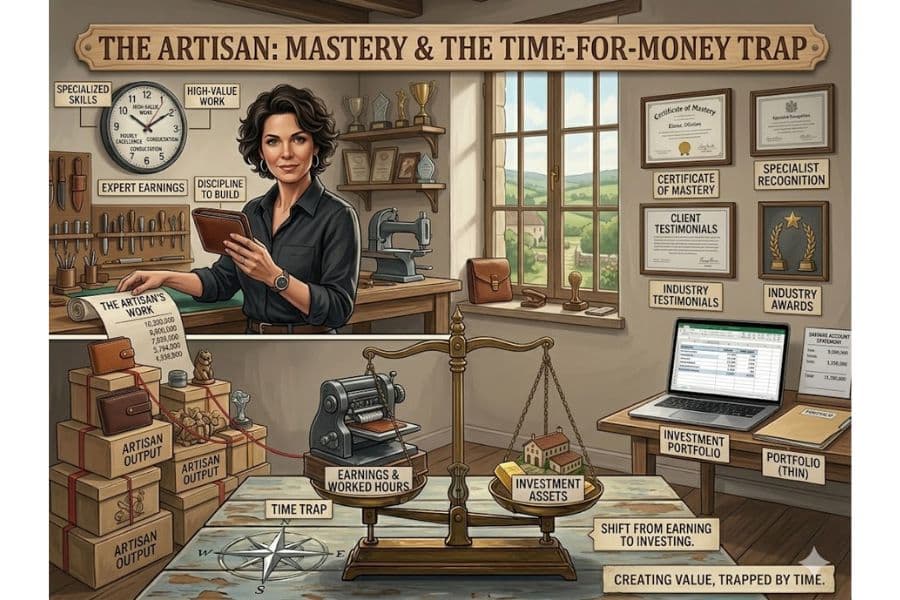
You believe mastery is the path to wealth. You’re an expert and a specialist, which is why you get paid well, because you’re excellent at what you do.
Your strength is focus and earning power. You have the discipline and the income to build serious wealth.
Your blind spot is the time-for-money trap. Even a high salary can leave you with a low net worth if your money isn’t working while you sleep. Many Artisans arrive at retirement with impressive careers and surprisingly thin investment portfolios.
For retirement, the shift you need to make is from earning to investing. Your money needs to be building assets, not just sitting in a savings account.
The Freedom Seeker
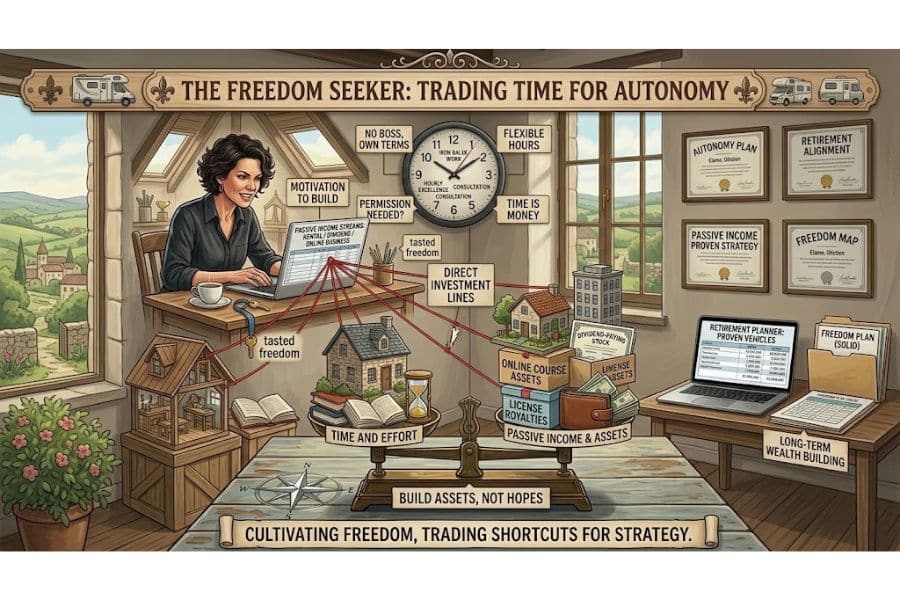
You want out, but not in a negative way. You just want life on your own terms, with no boss, no schedule, no permission needed. Money, to you, is time.
Your strength is motivation. You’ll put in extraordinary effort to build passive income streams because the reward, real freedom, is something you can taste.
Your blind spot is impatience. That hunger for freedom can push you toward shortcuts—get-rich-quick schemes, speculative investments, and risky bets that promise everything and deliver nothing.
For retirement, your instincts are well-aligned with long-term wealth-building. You just need to channel them into proven strategies rather than exciting ones.
Why Your Personality Shapes Your Bank Account
Psychologists use a model called the Big Five to measure personality. Studies on millionaires in Germany found that wealthy people, particularly self-made ones, consistently score differently than the average person across five key traits.
They tend to score higher in conscientiousness, which means they’re organized, disciplined, and follow through. Higher in openness, meaning they’re curious and willing to take calculated risks. Higher in extraversion, which helps them find opportunities and build networks, but lower in agreeableness, meaning they’re comfortable with conflict, useful when negotiating salaries or deals. And lower in neuroticism, meaning they don’t panic when markets drop.
Importantly, this personality profile was far more common among self-made millionaires than among those who inherited wealth, telling us that personality may be a key driver of wealth, not just a byproduct of it.
One study also found that specific personality traits are linked to higher annual earnings. Extroverts earned nearly $9,400 more per year on average. People who are objective in their thinking earned around $8,400 more. And organized, structured personalities earned around $6,900 more.
The Brain Traps That Quietly Drain Your Retirement Savings
Your personality makes you more vulnerable to specific mental biases, and those biases cost you money.
Loss aversion means the pain of losing money feels roughly twice as powerful as the pleasure of gaining the same amount. This causes people to hold onto falling investments long after they should sell, hoping they’ll recover.
Confirmation bias means you naturally seek out information that supports what you already believe. If you love a particular investment, you’ll unconsciously filter out the warning signs.
Anchoring means your brain latches onto the first number it hears. If your house was worth more two years ago, that number becomes the only one that feels real, even if the market has moved on.
- Strategic Accumulators are most at risk of loss aversion
- Maverick Creators are prone to overconfidence
- Connectors struggle with social spending
- Artisans anchor to their salary as their main measure of financial health
- Freedom Seekers are vulnerable to speculative bets.
Knowing your archetype means knowing which trap is most likely to catch you.
Scarcity vs Abundance: The Mindset Shift That Changes Everything
Two people can have identical incomes and end up in completely different financial positions at retirement. Often, the difference comes down to mindset.
A scarcity mindset is rooted in fear: there’s not enough; someone else’s success means less for me; and taking a risk could wipe me out. This thinking keeps people in safe, low-return positions their entire working lives.
An abundance mindset is rooted in possibility: there are opportunities; other people’s success is proof that mine is possible too; and managed risk is a tool, not a threat.
Let me give you an example. When the stock market drops, a scarcity mindset says sell everything before it gets worse. An abundance mindset says this could be a good time to buy quality assets at a lower price.
When a friend gets a promotion, scarcity says, “Why them and not me?” Abundance says, “What can I learn from how they got there?”
When a side hustle idea comes up, scarcity says, “What if it fails?” Abundance says, “What’s the realistic upside, and how do I manage the downside?”
Financial psychologist Dr. Brad Klontz calls our hidden beliefs about money “money scripts.” These are ideas formed in childhood, often without us realizing it, that run our financial decisions on autopilot. Things like “spending is dangerous,” or “wealthy people are greedy,” or “I’m just not a money person.”
The National Study of Millionaires, which surveyed over 10,000 millionaires, found that 97% believed they were in control of their own destiny. That compares to just 55% of the general population who felt the same way.
Your Retirement Action Plan, By Archetype
Knowing your type is only useful if you do something with it. Here’s where to start.
Strategic Accumulator
Automate your investments so your best habit runs without willpower. Set up automatic monthly transfers and use an escalation feature to increase your savings rate by 1% every six months.
Create a separate account called something like Fun Money and automate a small amount into it each month. Give yourself permission to spend it guilt-free. After all, you’ve earned it.
Push yourself to take one calculated risk you’ve been avoiding. A dividend-growth fund or a real estate investment trust (REIT) is a sensible starting point.
Maverick Creator
Hire someone to manage the details you hate. A bookkeeper or financial planner handling the mechanics frees you to do what you actually do well.
Use a three-bucket system. One account for operations and bills, one for your next venture, and one for boring index fund investments that you transfer to automatically and never touch.
Every quarter, write down your main financial mission. It only has to be one sentence. This helps you say no to distractions without feeling like you’re missing out.
Connector
Find a way to scale your network. A paid newsletter, a mastermind group, and consulting. Stop trading your time for commissions.
Set a fixed monthly generosity budget. Once it’s spent, the answer is no until next month. It’s about protecting your future self, not stopping you from being a generous person.
Budget specifically for things that grow your network, conferences, dinners, and events. Treat it as an investment, because it is for you.
Artisan
Buy your first money-making asset this year. A rental property, a portfolio of dividend stocks, a REIT. The goal is to have something generating income that doesn’t require your time.
Apply the same focus you bring to your craft to learning about money. One financial book a month, or a podcast on your commute. Your income is impressive, but your financial knowledge needs to catch up.
Work with a tax professional to make sure you’re using every tax-advantaged account available to you. High earners often pay far more tax than they need to.
Freedom Seeker
Pick one passive income stream and commit to it for twelve months. Real estate, an online business, a content channel. One thing. Don’t let anything else distract you.
Build a freedom fund of six to twelve months of living expenses in a high-yield savings account. Real freedom comes from having a cushion, not from hoping things work out.
Set up an automatic investment into a simple index fund alongside whatever else you’re building. This is your safety net and your retirement guarantee, even if your other projects take longer than expected.
The Money Beliefs That Are Secretly Running Your Finances
Before you finish, there’s one more thing worth examining. The beliefs you picked up about money long before you ever earned any.
Ask yourself these three questions about any money belief you hold:
Where did it come from? Most go back to childhood and to what your parents said or what you saw happen around you.
Is it still true today? A belief formed when you were eight years old may have made sense at the time, but it almost certainly doesn’t now.
Is it helping you or holding you back?
Common ones that sabotage retirement savings include “I’m just not good with money,” “saving feels selfish,” “investing is only for people who already have money,” and “it’s too late to make a real difference now.”
None of these is a fact. They’re old stories that can be rewritten.
The most powerful thing you can do for your retirement isn’t always to find a better investment, but to understand the person making the financial decisions. Because that person is you, every single time.
Disclaimer: This article is for informational purposes only and does not constitute financial advice. Always consult a qualified financial advisor before making decisions about your retirement or investments.