
I’ve never quite been able to reconcile myself with the way tax works. You work for 40-odd years, pay tax on every paycheck along the way, and then, when you’re finally drawing the money back out, the IRS wants another bite. How is that fair?
Well, it’s like most things in life: if you read the small print, you realize there are ways and means, all legal, of course, for paying out less to the IRS. It’s all about asking the right questions.
So, instead of asking how much I can withdraw, the question you should really be asking is which bucket I should pull it from? That little reframe and a wee bit of knowledge highlight some rather lucrative tax loopholes for retirees.

7 Tax Loopholes for Retirees
These 7 tax loopholes are completely legal; most people just don’t realize they exist, so they never take advantage of them. Remember, though, don’t do anything without consulting your financial advisor.
1. The Roth Conversion Window Between Retirement and Age 73

There’s a sweet spot most people miss completely, which is the gap between the year you stop working and the year Required Minimum Distributions kick in at 73.
Your earned income has dropped to nothing, or close to it, but the IRS isn’t yet forcing you to withdraw money from your traditional IRA or 401(k). For many retirees, that’s a decade of very low taxable income.
What you do in that window is convert chunks of your traditional IRA into a Roth IRA, paying tax now at your current low bracket rather than later at whatever bracket the RMDs and Social Security together push you into.
Once the money’s in the Roth, it grows tax-free forever, comes out tax-free, and never has an RMD attached to it. Your heirs inherit it tax-free too, which is worth knowing if leaving something behind matters to you.
The trick isn’t to convert so much in one year that you shove yourself into a higher bracket or trigger a Medicare premium surcharge (IRMAA). Most people fill up the 12% or 22% bracket and stop.
Done every year for 8 or 10 years, it can move six figures out of the taxable column entirely.
2. The 0% Long-Term Capital Gains Bracket

If your taxable income for 2026 sits below roughly $48,350 single or $96,700 married filing jointly, your long-term capital gains are taxed at zero percent. You can look up the current thresholds directly on the IRS capital gains page.
So if you’re living off some cash savings and a modest pension in the early years of retirement, and you’ve got a taxable brokerage account with appreciated stock sitting in it, you can sell shares up to that income limit and pay nothing in federal tax on the gain.
Then, if you still want to own the stock, buy it right back the same day. The wash-sale rule only applies to losses, not gains, so it’s a perfectly clean move. That resets the cost basis and washes decades of gains out of the account tax-free.
It’s known as “tax gain harvesting”. You need to watch state taxes (some states will still charge you), and keep an eye on how the extra income affects Social Security taxes and Medicare premiums. Done thoughtfully, though, it’s one of the cleanest ways to move money out of the taxable column without the IRS getting a cent.
3. Qualified Charitable Distributions From Your IRA
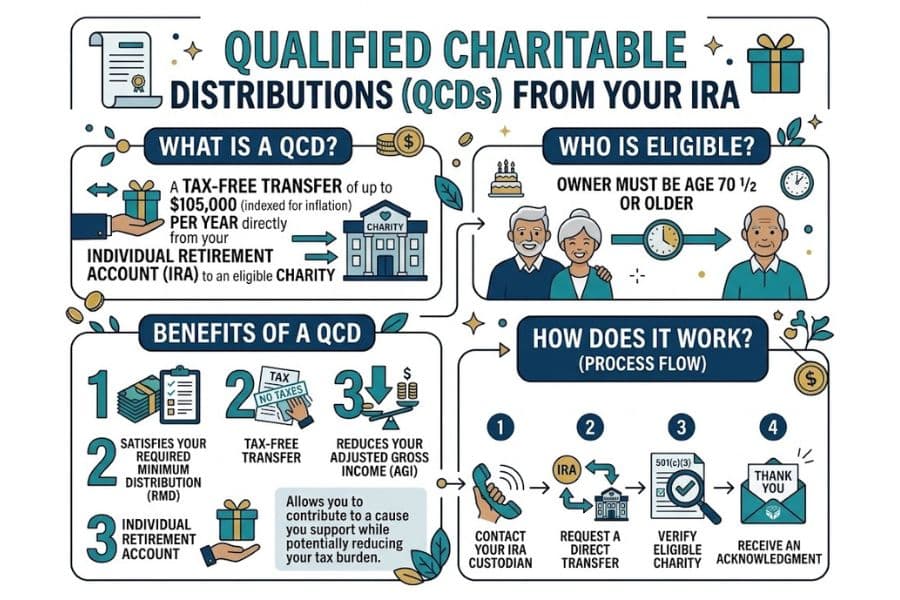
If you’re 70½ or older and you give to charity anyway, the Qualified Charitable Distribution is worth its weight in gold. You can direct up to $108,000 in 2026 straight from your traditional IRA to a qualified charity, and that money never touches your tax return. It counts toward your RMD if you’re subject to one, but it doesn’t count as income.
Compare that to the normal route, which is: take the RMD, pay tax on it, then write a check to the charity and try to deduct it.
Since the standard deduction went up, most retirees no longer itemize, so the charitable deduction is worth nothing to them.
The QCD sidesteps that whole problem. The money goes directly from your IRA custodian to the charity, and your reported income is reduced by the amount you sent.
Lower reported income has a ripple effect too. It can drop the taxable portion of your Social Security, keep you under the IRMAA cliffs for Medicare, and shrink your state tax bill in states that follow federal AGI.
If you were giving $5,000 or $10,000 a year to your church or a food bank anyway, doing it as a QCD instead of writing a personal check can save you real money on the same donation.
The full rules are laid out on the IRS QCD page.
4. The Health Savings Account Nobody Talks About in Retirement

The HSA is the most tax-advantaged account in the entire United States tax code, and hardly anyone treats it as a retirement account. Contributions are pre-tax, growth is tax-free, and withdrawals for qualified medical expenses are tax-free.
Three layers of tax protection on the same dollar, which no other account offers.
There’s no time limit on reimbursing yourself for a medical expense. If you paid $4,000 out of pocket for a hip procedure in 2027 and kept the receipt, you can leave that money invested in the HSA for 20 years, then pull $4,000 out tax-free in 2047 as reimbursement for the 2027 bill.
The HSA can grow untouched for decades, and in your 70s you can withdraw large tax-free chunks whenever you like, backed by receipts from earlier years.
After age 65, if you run out of medical receipts entirely, the HSA turns into something close to a traditional IRA. Withdrawals for non-medical reasons are taxed as ordinary income (no penalty), which puts it on par with a 401(k) at worst and infinitely better at best.
Medicare premiums, long-term care insurance premiums, dental, vision, hearing aids all count as qualified medical expenses, and most retirees will spend well into six figures on those over a lifetime.
5. The Delayed Social Security “Raise” That Isn’t Taxed As Wages

Every year you delay claiming Social Security past your full retirement age (up to 70), the benefit grows by 8% for life. That’s an 8% guaranteed raise from the federal government, backed by inflation adjustments on top, and there’s nothing you can buy in the market that comes close to it.
You can see the delayed retirement credit schedule on the official SSA delayed retirement page.
Social Security is only partially taxable, and how much of it is taxed depends on your “provisional income” (your other income plus half of your benefit).
So a bigger Social Security check paired with smaller withdrawals from your IRA can produce a much lower total tax bill than a smaller Social Security check paired with bigger IRA withdrawals, even though the total income coming in is identical.
Same money, less tax.
Married couples can layer this. The higher earner delays to 70 to maximize the survivor benefit (which the surviving spouse keeps for life), while the lower earner claims earlier to bring in some cash.
If the higher earner passes first, the survivor steps up to the bigger benefit, which is inflation-protected and lasts as long as they do.
6. Moving to a State That Doesn’t Tax Retirement Income

Federal tax is federal tax, and there’s no escaping it inside the country. State tax is a completely different beast and can vary substantially.
Nine states have no state income tax at all: Alaska, Florida, Nevada, New Hampshire, South Dakota, Tennessee, Texas, Washington, and Wyoming.
Several others (Illinois, Mississippi, Pennsylvania) don’t tax retirement income specifically, even though they tax wages.
On an $80,000 retirement income, moving from a state with a 6% income tax to a state with none puts $4,800 a year back in your pocket. Over a 25-year retirement, that’s $120,000, not adjusted for what it would have earned if invested.
And it’s not just income tax to think about. Property tax, sales tax, and estate tax vary wildly by state too. Florida is famously friendly on all counts, which is why the license plates fill up down there every year.
Obviously, taxes should never be the only reason to uproot your life. Being near grandchildren, doctors you trust, and friends you actually see counts for more than a tax bill. But if you were going to move anyway, or if you’re a snowbird spending half the year somewhere warm, establishing residency in the tax-free state rather than the taxed one.
The residency rules are strict, and states like New York will chase you, so this needs doing properly with proof of address, driver’s license, voter registration, and time-in-state records.
7. The Home Sale Exclusion Most Retirees Only Get to Use Once

When you sell your primary residence, the first $250,000 of gain is tax-free if you’re single, and the first $500,000 is tax-free if you’re married filing jointly.
You must have lived in the house as your primary residence for at least 2 of the last 5 years, and you can use the exclusion once every 2 years. Full details are on the IRS home sale exclusion page.
For a retiree downsizing out of the family home after 30 years of appreciation, this is enormous. A house bought for $180,000 in 1995 that now sells for $780,000 has a $600,000 gain, and a married couple can shelter $500,000 of that gain outright.
The remaining $100,000 gets taxed at long-term capital gains rates, which (see loophole #2) might be zero if your income is low enough that year.
Some people move to use this exclusion more than once during their retirement. You sell the family home, take the $500,000 tax-free, buy a smaller place, live in it for at least two years, sell that one and use the exclusion again.
Do it a couple of times over 10 or 15 years and you’ve moved a lot of appreciated real estate out of the taxable column without the IRS collecting on any of it.