
Immersive travel is the latest travel trend getting everyone excited in 2025, and it’s one I’m happy to embrace. The thought of slowing down and really immersing myself in the culture of the place I’m visiting appeals to me. So often with a cruise, you don’t really get to fully immerse yourself in a place, as there simply isn’t enough time. And Norway is leading the charge.
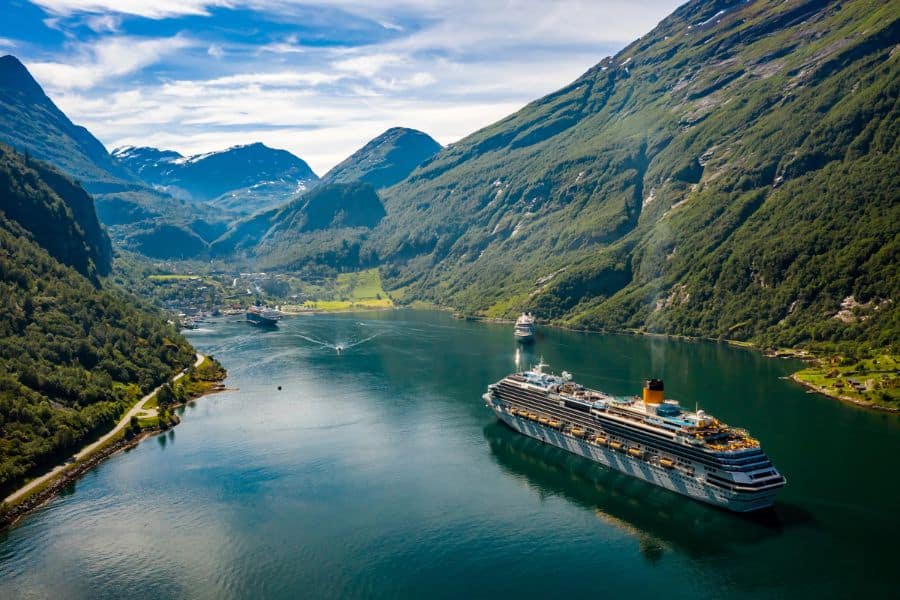
Norway is the fastest-growing international destination for U.S. tourists, with bookings up 69% year over year, according to Viator. With fjords, northern lights, quaint cities, and Europe’s quietest capital, this darling of the cool-weather travel trend welcomes travelers seeking thoughtful adventure. The best way to see it is by cruise ship, and business is booming.
Cruise Lines International Association estimates 39.6 million passengers will embark on a cruise in 2026, a 13% increase over 2024. Travelers are being seduced by a new kind of cruise, one that offers convenience and abundant food and drink but also culture, killer natural beauty, and in 2026, the solar eclipse path of totality.
Can Cruise Travel Really Be Immersive?
Immersive cruise travel is all about getting to know a destination deeply by slowing down and integrating with the local culture, and it is wildly popular in 2025. This trend serves as a backlash against overtourism and selfie culture. But can a cruise really offer experiential travel, when port stops average just eight hours?
“Enjoying nature is in our soul,” the guide from Havrafting Sør says, leading a group off of a rigid inflatable boat and up into the Ny-Hellesund fortress, a World War 2 installation overlooking the Kristiansand archipelago in eastern Norway. Contrary to the weather forecast, blue skies grace a crisp fall day. Regardless, in Norway, they say there is no bad weather, only bad clothes.

Peering down on the pine-dotted outcroppings as sheep trundle by, it’s hard to remember having ever been anywhere else, let alone disembarking a cruise ship a mere hour before. As soon as you set foot on land, Norway draws you in, and the guides are happy to share their land’s bounty. The Norwegian notion of “friluftsliv,” or nature belonging to all, is a throughline of shore excursions.
“The cruise lines want us to take more passengers,” the guide admits. He refuses, preferring to keep numbers low to avoid damaging the fragile ecosystem. Throughout Norway, nature and the responsibility to care for it belong to everyone. “We are all park rangers for each other.”
Diving deeper
With multiple stops in the same country, this new kind of travel is a far cry from the manufactured, shallow experiences cruising once embodied. Visitors leave with a deeper understanding of Norway, from its Viking roots and World War II history to how it grapples with today’s challenges like sustainability.
Holland America Line partners with The HISTORY Channel to offer itineraries with specialized excursions. These day trips take cruisers beyond the surface of a place. You can read more in this Holland America cruise line review.

In Stavanger, that exploration spans an ancient stone circle, an Iron Age longhouse, the scene of a pivotal Viking battle, and a look at the modern oil industry. The multi-faceted tour nudges travelers to explore a side of Norway they likely wouldn’t stumble on by themselves.
The cultural program continues onboard, with educational talks that offer passengers an in-depth look at upcoming ports of call. Another presentation shares insights on the Norwegian way of finding joy. In the restaurants, Norwegian-inspired dishes grace the menu. Whatever you do, don’t skip the fish.
Fresh fish at sea is harder than it seems
Creamy fish soup is a Norwegian staple, but Holland America Line’s commitment to fish goes beyond a nod to the classic dish. Through its global fresh fish program, the cruise line partners with 60 vendors to source fresh, local fish wherever possible.
Onboard, guests know it as the port to plate initiative, which highlights items from local fishermen, prepared fresh within 48 hours. On the menu, a section of Northern Europe-inspired dishes beckons diners. On offer is Norwegian-style cured salmon gravlax, baked Norwegian seafood thermidor, and Icelandic turbot.

The logistics behind getting fresh fish to thousands of passengers in less than 48 hours while on a cruise are considerable. It’s even tougher when international sustainability certification rules for seafood govern it. One fish purveyor in Rotterdam relishes the challenge.
Along with providing more than 1,000 kg, or 2,204 pounds, of fresh fish to Holland America Line on every sailing from Rotterdam, Schmidt Zeevis pioneers new ways to flash-freeze fish. Faster freezing prevents ice crystals from growing around the fish’s cells, maintaining the texture and quality of fresh fish with the longevity benefits freezing provides.
Strides toward sustainability
Making frozen fish taste as good as fresh means less spoilage and less waste. It’s just one small piece in the overall sustainability puzzle that is modern cruising.
Norway takes the environmental impact of cruising seriously, especially after its fjords received World Heritage Status in 2005. A 2018 resolution by the Norwegian government requires cruise ships to achieve net zero emissions by 2026. I
n a nod to the feasibility challenges associated with running cruise ships on battery technology alone, in 2024, the deadline was pushed to 2032. Cruise lines aren’t waiting, despite the extended deadline.

On Rotterdam, Holland America Line’s newest ship, sustainability touches everything. Major systems take the lead, with carbon emissions scrubbed to remove 90% of all particulates. Small details aren’t overlooked, though, like the butter, which is served in dishes rather than individually wrapped.
Maybelle Baijens-Lim, food and beverage director on Rotterdam, shares that smart provisioning and creative menu planning mean their food waste onboard is just 0.39 kg, or 0.86 pounds per person, per day.
The cruise industry still has a long way to go on sustainability, but it’s making strides toward both Norway’s requirements and the International Maritime Organization’s 2050 net-zero emissions goal. Heat from Rotterdam’s engines powers desalinator plants onboard, which create all of the ship’s drinking water. Excess heat is channeled to warm water for bathing and laundry. Advanced wastewater treatment facilities enable the ship to release clean water back into the ocean and store compacted waste for land disposal.
Norway’s extensive and growing port infrastructure, upgraded with an onshore power supply, allows cruise ships to power down in port. This saves 98% of emissions, depending on the mix of energy sources. Together with improvements in ship design and pilot projects using biofuels, the industry is responding to the delicate balance travelers demand between cost, quality, and sustainability.
Conscious Cruising

Norway is growing quickly as a travel destination, and cruising makes it easy to enjoy friluftsliv without sacrificing comfort or convenience. Thought-provoking excursions, fresh ingredients, and a commitment to environmental responsibility blend the best of cruising with the values of Norway, proving that cruising can indeed be full of both breadth and depth.
Ashley Wali is a Seattle-based travel journalist and curator of Wanderlux, specializing in luxury family travel, sports tourism, and wellness travel. Her work has appeared in The Seattle Times, Boston Herald, The Philadelphia Tribune, Orlando Sentinel, and many more. Recent assignments have had her slurping oysters on Cape Cod and whale watching in the Salish Sea.
This article originally appeared on Food Drink Life.