
Most of us have a complicated relationship with money. We know we should be saving more, we fully intend to cut back, and then somehow the month ends, and we’re not entirely sure where it all went. Sound familiar?
A dinner out here, a sale you couldn’t ignore there, a random expense you didn’t see coming, and by the time the month ends, you’re looking at your bank balance, wondering where it all went.
Well, the good news is, it’s not you, it’s the budgeting system. It sets you up to fail. There’s a 120-year-old Japanese method called Kakeibo (pronounced “kah-keh-boh”) that takes a completely different approach.

Why Most Budgeting Methods Don’t Work
Before we get into Kakeibo, it helps to understand why traditional budgeting fails so many people, because it almost certainly isn’t what you think.
The standard advice goes something like this: cut your coffee to one a week, cook every meal at home, cancel the subscriptions you don’t use, stop buying things you don’t need. It sounds perfectly logical, but the problem is that spending isn’t logical. It’s emotional.
We buy things when we’re stressed, when we’re bored, when we’re celebrating, when we’re sad, and often on autopilot without thinking at all. Behavioral economists call this emotional regulation spending, and it’s why a strict budget often triggers the very behavior it’s trying to prevent. The moment you tell yourself you absolutely cannot buy something, the craving for it doubles.
Sound like a diet? It behaves exactly like one. You restrict hard, hold out for a few weeks, then crack and spend in ways that undo all the progress you made. Researchers actually call this phenomenon “budget fatigue,” and it explains why surveys consistently show that while most people have made a budget at some point, a significant chunk of them rarely or never follow it.
There’s another problem, too. Most budgets are built on the idea of an ideal version of you: more disciplined, more organized, better at saying no than you’ve ever actually been. Psychologists call this the planning fallacy. We genuinely believe that future us will handle things better than past us ever did. The budget reflects our best intentions rather than our real habits, so it falls apart the moment real life shows up.
And then there’s the shame spiral. You overspend one week, feel terrible about it, avoid looking at your finances, fall further behind, and feel even worse. Most traditional budgeting systems have no mechanism for this very human response. They just record your failure and wait for you to try again next month.
Kakeibo sidesteps all of that.
So What Is Kakeibo?

Kakeibo translates to “household financial ledger.” It was created in 1904 by Hani Motoko, Japan’s first female journalist, who published it in a women’s magazine specifically designed to help homemakers manage their household finances.
Over a century later, the method is still widely used in Japan and has gained real traction in the West since author Fumiko Chiba published a guide to it in English in 2017.
The reason it’s lasted 120 years is that it’s built around something that never changes: human psychology.
Kakeibo asks you to do four things. Write down what you have. Decide what you want to save. Track what you spend. Reflect on how it went.
That last part is where the real magic happens, and it’s what separates Kakeibo from every app, spreadsheet, and budgeting template you’ve tried before.
Why a Pen and Paper Make All the Difference
Kakeibo insists on handwriting. Not a phone app or spreadsheet, but a physical notebook with ink on paper. But why is this such an important detail?
Well, when you tap a number into an app, you process it for half a second and move on. The information registers briefly and then disappears into the background noise of your phone. But when you write a number down by hand, you slow down. You hold the information in your mind for a moment longer. You feel the physical act of recording it.
Research consistently shows that handwriting engages the brain at a different level than typing, creating a stronger connection to what you’re recording.
There’s also a subtle accountability effect. Knowing you’ll have to write something down later changes how you feel about spending it. It’s a pause that apps are specifically designed to eliminate because the faster you can buy, the more you buy. Kakeibo deliberately restores that pause.
The Four Categories Kakeibo Is Built On
One reason traditional budgeting gets so tedious is the number of categories involved. Groceries, dining out, clothing, personal care, entertainment, subscriptions, gifts, travel, household expenses: it never ends, and keeping track of all of them creates the decision fatigue that makes people give up.
Kakeibo uses just four.
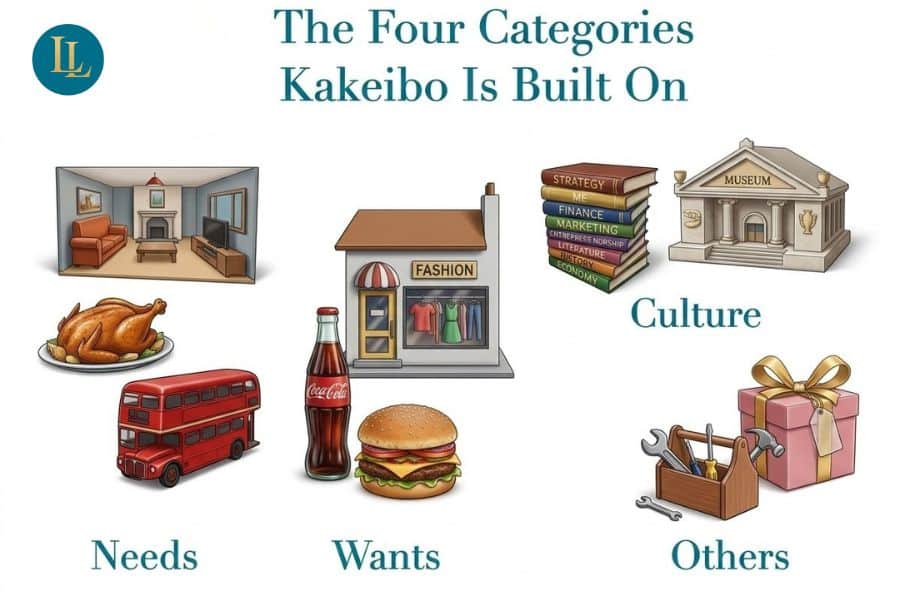
No. 1 Survival
This covers everything you genuinely cannot live without. Rent or mortgage, utilities, groceries, healthcare, transport. These are your baseline, your non-negotiables.
No. 2 Optional Wants
This is everything enjoyable but not essential. A meal out, a new pair of shoes, a beauty product you fancied, that online purchase you talked yourself into during a weak moment.
No. 3 Culture
This is a category most Western budgeting systems ignore entirely, and its inclusion says something important about the Kakeibo philosophy. Books, museum visits, a cooking class, a concert, a course you’re taking online. These are part of a full life, and treating them as legitimate spending rather than something to feel guilty about is a meaningful distinction.
No. 4 Unexpected Extras
Car repairs, vet bills, a birthday you forgot was coming, an emergency. Real life constantly produces costs that don’t fit neatly into a budget, and Kakeibo builds a home for them rather than pretending they won’t happen.
That’s it. Four buckets, broad enough that everything fits somewhere, specific enough that you start seeing where your money actually goes.
The Four Questions You Answer Every Month
At the start of each month, before you spend a single dollar, Kakeibo asks you to sit down and work through four questions that underpin the entire system.

How much money do I have available this month?
Write down your income after tax. Then subtract your fixed, non-negotiable expenses, the ones that stay the same every month. What remains is the money you actually get to make decisions about. Seeing that real number written on paper, rather than assuming it somewhere in the back of your mind, is often the first moment of clarity.
How much would I like to save?
Here’s where Kakeibo diverges from how most of us have been taught to approach saving. Rather than saving whatever happens to be left over at the end of the month (which, for most people, is very little), Kakeibo asks you to decide on your savings amount first and treat it as a bill that must be paid before anything else.
Move that money somewhere you won’t accidentally spend it. It becomes non-negotiable, just like your rent. Kakeibo encourages you to name it. A trip you want to take, a cushion for emergencies, or a big purchase you’ve been putting off. Attaching a reason to a savings goal makes it feel real rather than abstract, and real goals are far easier to protect.
How much am I actually spending?
As the month goes on, you write every purchase in your notebook and assign it to one of the four categories. Every coffee, every grocery run, every small online impulse, every unexpected bill.
Seeing everything together, written down in your own handwriting, makes invisible patterns visible. The small things that never felt like decisions suddenly have a number attached to them.
How can I improve?
Most budgeting methods treat the end of the month as a reckoning. You either met your targets or you didn’t. If you didn’t, the implied message is that you need more discipline next time. Try harder. Want it more.
Kakeibo treats the end of the month as a learning opportunity, not a performance review.
The “how can I improve” question is deliberately open-ended. It’s not asking where you failed, but what you noticed, what surprised you, and what you’d do differently with that information.
Maybe you discovered you spend far more on convenience purchases than you realized, the quick online orders when you’re tired and can’t face cooking. Maybe you noticed that the category where you overspent most was one that actually brought you genuine enjoyment, and you want to consciously protect that spending rather than cut it.
None of these insights is available when you just check the total at the end of the month on an app. They only emerge when you’ve been writing things down and sitting with them. Writing creates awareness, and awareness creates change.
There’s no shame in the Kakeibo system. If you overspent, you look at why and adjust. If you under-saved, you look at whether your original goal was realistic or too ambitious. The process is forgiving by design because shame has been shown to worsen financial avoidance, not improve it.
A Practical Guide to Starting Your First Kakeibo Month
Before the month starts, sit down with your notebook and calculate your income after tax. Write it at the top of a fresh page. Below it, list your fixed monthly expenses, everything that goes out regardless of what you do: rent or mortgage, utilities, insurance, and any regular debt payments. Subtract them from your income. The number you’re left with is your real available money for the month.
From that number, write down your savings goal and the reason you’re saving. Transfer that amount to a separate account as soon as your income comes in, before the month begins in earnest.
What remains is what you have to work with across your four categories.
As the month goes on, write down every purchase the same day you make it, if possible. If that feels like too much, block out ten minutes every evening to update your notebook, or set aside half an hour each Sunday. The key is regularity. The more consistent you are, the clearer the picture becomes.
At the end of the month, total up each category. Then sit with the numbers and answer that fourth question honestly. What went well? What surprised you? What will you do differently?
That’s your first Kakeibo month complete. The second one will feel easier because you already know your real numbers. By the third month, you’ll start to see patterns you never saw before.
What Kakeibo Is Really Asking You to Do
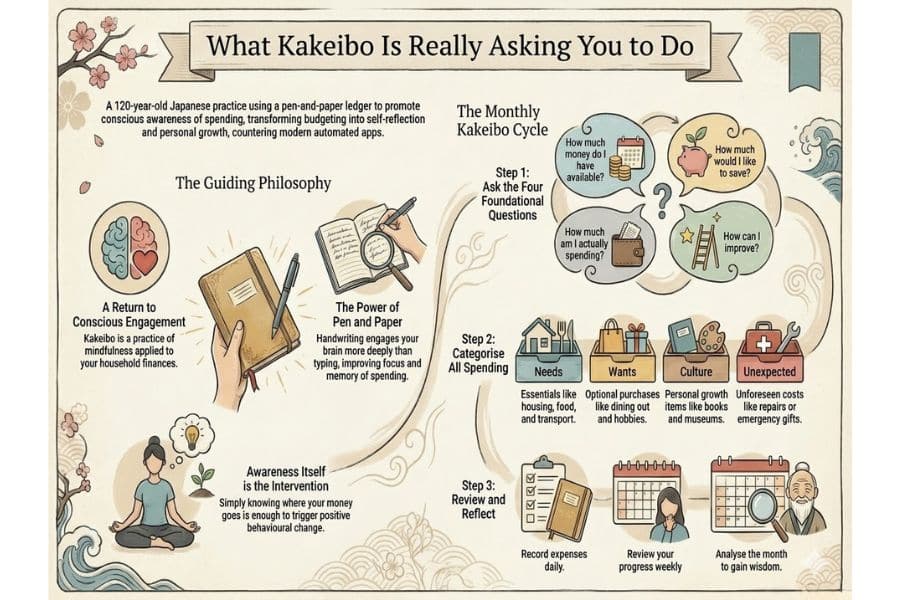
Underneath the notebook, the four categories, and the monthly questions, Kakeibo is asking something more fundamental. It’s asking you to examine your relationship with money rather than just try to control your behavior around it.
Most budgeting systems treat spending as a math problem. Get the numbers right, and the problem is solved. But spending is a values problem as much as it is a math one. When you spend money, you’re making a statement about what matters to you, what brings you comfort, what you’re prioritizing without thinking, and what you want your life to look like.
Kakeibo makes those statements visible. And when you can see them clearly, you get to decide whether they actually reflect what you want, or whether habits and impulses have been making the decisions on your behalf.
For anyone thinking about what the next chapter looks like financially, whether that’s paying down a mortgage, building a retirement cushion, funding travel, or simply getting a clearer picture of where the money goes, this is a remarkably powerful starting point.
Disclaimer: The information in this article is for general informational purposes only and does not constitute financial advice. Please consult with a qualified financial advisor before making changes to your personal financial arrangements.